
What Are Pediatric Feeding Disorders?
For many families, feeding is something they expect to happen naturally. But for some children, even the simplest parts of eating and drinking can be difficult.
An infant may struggle to latch or drink efficiently from a bottle. A toddler may have trouble transitioning from purees to table foods. An older child may eat only a limited number of foods or have difficulty chewing and swallowing certain textures.
Successful feeding depends on several systems working together. A child must be able to coordinate breathing, sucking, biting, chewing, and swallowing while also managing the sensory experiences that come with eating.
When these skills don't develop as expected, feeding can become frustrating, exhausting, or even unsafe.
Feeding difficulties may be related to oral-motor coordination, sensory processing, medical or structural conditions, swallowing function, or a combination of factors.
At Crossroads, we recognize that feeding difficulties are not always about the food itself. Understanding why a child is struggling helps us determine where treatment needs to begin.
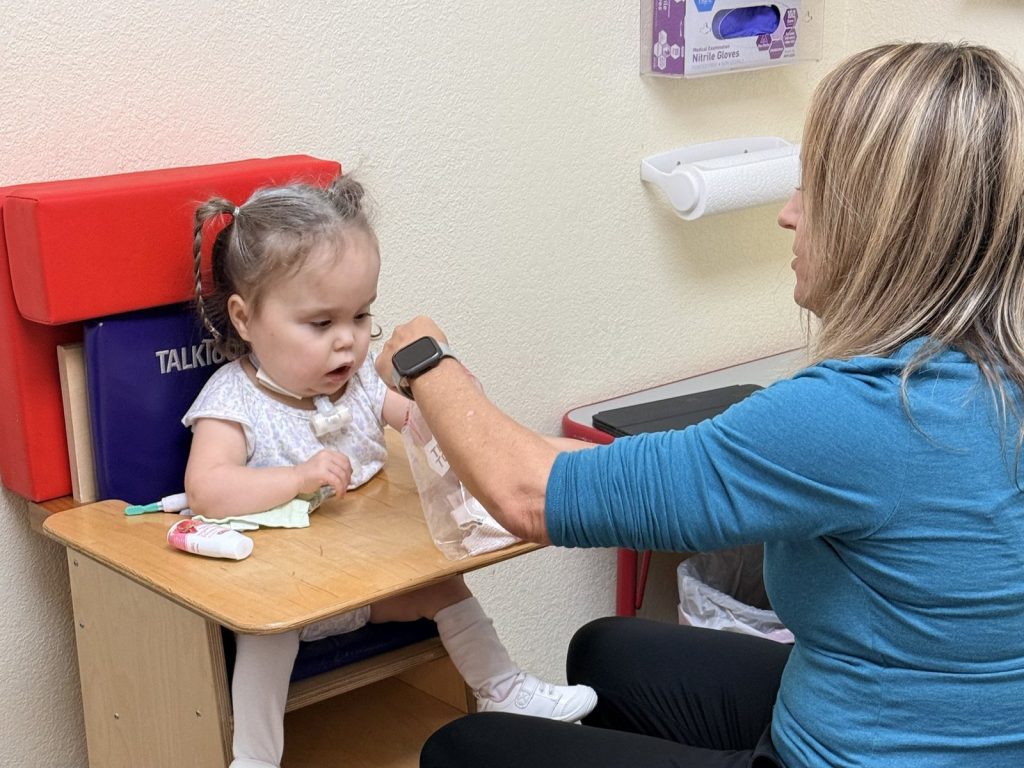
What Do Feeding Difficulties Look Like?
Feeding challenges can appear at any stage of development. Some children have difficulty from their earliest breast or bottle feeds, while others begin struggling when they are introduced to new textures or expected to develop more advanced eating skills.
Some signs that a child may benefit from a feeding evaluation include:
- Breastfeeding or bottle-feeding difficulties: Trouble latching, milk leaking from the mouth, inefficient sucking, frequent breaks, fatigue, or difficulty coordinating sucking, swallowing, and breathing.
- Difficulty moving to solid foods: Gagging, refusing textured foods, difficulty biting pieces of food, or remaining dependent on purees longer than expected.
- Limited food variety: Eating only a small selection of foods, avoiding entire food groups or textures, or insisting on specific brands or presentations.
- Chewing difficulties: Swallowing food before chewing it adequately, using primarily one side of the mouth, difficulty moving food onto the back teeth, or holding food in the cheeks.
- Sensory feeding challenges: Strong reactions to certain textures, temperatures, smells, or the experience of having food in or around the mouth.
- Possible swallowing difficulties: Coughing, choking, changes in breathing, or congestion associated with eating or drinking.
- Stressful mealtimes: Refusal, distress, prolonged meals, or increasing frustration for the child and family.
- Growth or nutritional concerns: Difficulty getting enough nutrition or hydration, poor weight gain, or dependence on a very limited range of foods or feeding methods.
A child does not need to demonstrate every one of these signs to have a feeding difficulty. Some children grow adequately but still struggle with important feeding skills.
A comprehensive feeding evaluation helps us understand which systems are contributing to the difficulty and what support the child may need.
The Feeding Difficulty Is Only Part of the Picture
When a child refuses a food, gags on a texture, or struggles to finish a bottle, it's easy to focus on the behavior we can see. But the reason behind that difficulty may be much more complicated.
A child who avoids meats may have trouble chewing them effectively. An infant who pulls away from the bottle may be struggling to coordinate sucking, swallowing, and breathing. A child who holds food in their cheeks may not have developed the tongue movements needed to manage it.
Sensory experiences, medical conditions, structural differences, and developmental diagnoses can also influence feeding. Children with Down syndrome, autism, neurological conditions, or other developmental differences may have several overlapping challenges affecting how they eat and drink.
These overlapping challenges matter because not every child with a feeding disorder needs the same treatment approach or is ready to begin with the same activities.
We often find that improving feeding requires us to look beyond the immediate concern. Sometimes we need to address how a child moves food in the mouth. Other times we need to consider positioning, breathing, swallowing safety, sensory comfort, or the child's previous experiences with feeding.
At Crossroads, we don't want to focus only on what a child will or won't eat. We want to understand what is preventing the child from feeding successfully and what skills or supports may need to be established first.
Sometimes that means taking a different path to reach the same goal.
Our goal is to help children develop the skills needed for safe, efficient, and comfortable feeding while supporting positive experiences with food and mealtimes.
How We Evaluate Feeding at Crossroads
Every feeding evaluation begins with understanding the child's history and the family's concerns.
We want to know what feeding has looked like from the beginning. Were there difficulties with breastfeeding or bottle feeding? How did the child transition to purees and solid foods? Are certain textures consistently difficult? What happens during a typical meal?
We review medical and developmental history, growth and nutritional concerns, previous evaluations, and any diagnoses or conditions that may influence feeding.
Then we look closely at the skills involved in eating and drinking.
For infants, we may observe breast or bottle feeding to assess latch, sucking patterns, milk transfer, oral control, endurance, and coordination of sucking, swallowing, and breathing. We also examine oral structures and movement patterns that may be affecting feeding.
For older infants and children, we observe how they manage appropriate foods and liquids. We look at jaw control, lip closure, tongue movement, biting, chewing, movement of food within the mouth, and swallowing patterns. We also pay attention to sensory responses, food acceptance, and the child's comfort during feeding.
One of the most valuable parts of an evaluation is seeing what happens when we make small changes. Does a different position improve bottle feeding? Can a child chew more effectively when food is placed on the back teeth? Does adjusting the size or texture of food help the child manage it more successfully?
We also use task analysis to examine the component movements required for feeding and identify where motor control or coordination may be limiting performance. This helps us decide whether a targeted pre-feeding activity could support a functional goal.
These responses give us information about the child's abilities and help us determine which skills or supports may be useful in treatment.
We also consider feeding and swallowing safety throughout the evaluation. When symptoms suggest possible swallowing impairment or other medical concerns, we may recommend additional testing, such as a modified barium swallow study, or consultation with the child's medical team. A clinical feeding evaluation alone cannot rule out aspiration.
Our goal is not simply to identify a feeding disorder. It is to understand the child well enough to develop an individualized treatment plan that addresses the barriers limiting successful feeding and supports safe, functional progress.
Individualized Treatment: Finding the Right Place to Begin
Feeding involves a complex combination of skills, and when something isn't working well, the solution isn't always as simple as changing the food or encouraging a child to take another bite.
At Crossroads Therapy Clinic, we look closely at what happens during feeding. Is an infant working too hard to get milk from a bottle? Is a child swallowing food before it has been adequately chewed? Does food collect in the cheeks because the tongue isn't moving it effectively? Or is the child avoiding certain foods because the sensory experience is overwhelming?
Each of these situations requires a different approach to treatment.
Our first question is not simply how to get a child to eat more foods, but what is preventing this child from feeding successfully?
Building the Skills Behind Successful Feeding
Sometimes, practicing feeding alone isn't enough to help a child develop a movement they haven't yet learned to perform consistently.
We use task analysis to break feeding activities into the smaller motor skills required for success. This helps us identify whether a child needs additional support with jaw control, lip closure, tongue movement, coordination, or the ability to organize these movements during feeding.
When appropriate, we incorporate targeted oral-motor activities, sensory-motor input, and pre-feeding exercises to help a child develop or practice a specific skill before asking them to use it during eating or drinking.
Activate the muscle. Use the muscle. Integrate it into function.
Every step stays connected to the functional feeding goal.
For example, if a child has difficulty moving food onto the back teeth, we may work on the tongue movements needed for lateralization, provide guided opportunities to practice that movement, and then help the child use it with an appropriate food.
If a child has difficulty maintaining jaw control during chewing, we may use structured activities to help them practice controlled jaw movements before integrating those skills into actual chewing.
This progression allows us to address a specific motor challenge while continually connecting the activity to the feeding skill we want the child to develop.
We may use Oral Placement Therapy (OPT), tactile cues, specialized tools, positioning strategies, or modifications to food presentation as part of this process. These supports are selected based on the child's individual needs and adjusted as skills develop.
A tool is a step in the learning process, not the goal of treatment.
We don't measure success simply by how well a child performs an exercise. We look for meaningful changes in actual feeding—more effective chewing, better management of food and liquids, improved feeding efficiency, and greater independence.
For children with sensory feeding challenges, treatment may also include helping them become more comfortable with foods, textures, and new experiences without pressure or force.
As children make progress, we gradually reduce external support and increase opportunities to practice their developing skills during meals.
Ultimately, our focus is on helping children become safer, more efficient, and more comfortable eaters while making mealtimes easier and more enjoyable for their families.
We don't expect every child to follow the same path. We work to understand where each child needs to begin and how to help them progress.
Infant Feeding & Tongue-Tie: Why a Functional Feeding Assessment Matters
Tongue-tie is often discussed as a possible cause of breastfeeding or bottle-feeding difficulties. While restricted tongue movement can contribute to feeding challenges, not every infant with a tongue-tie needs a surgical release, and not every feeding difficulty is caused by a tongue-tie.
At Crossroads Therapy Clinic, we believe a comprehensive functional feeding assessment is an important step before considering a frenectomy.
Our first question isn't simply whether a tongue-tie is present. It's whether the restriction is affecting feeding and what other factors may be contributing to the difficulty.
An infant may struggle with latch, suction, tongue coordination, jaw stability, milk transfer, or coordination of sucking, swallowing, and breathing. Some of these difficulties may be associated with restricted tongue movement, while others may have different underlying causes.
Without understanding how the baby was feeding before a release, it can be difficult to determine why feeding challenges continue afterward or whether the procedure addressed the primary concern.
Before a Frenectomy
We evaluate the baby's oral structures, movement patterns, and actual feeding performance to better understand which factors may be limiting feeding success. This establishes a functional baseline, identifies skills that may benefit from feeding therapy, and helps families and releasing providers make informed decisions.
Some infants improve with feeding support and do not require a release. Others may have functional restrictions that warrant further assessment by an appropriately trained medical or dental professional.
Our goal is to help families make informed decisions based on feeding function, not simply the appearance of a restriction.
After a Frenectomy
When an infant has undergone a release, our focus is on how the baby is functioning during feeding. A change in tongue mobility does not automatically mean that established feeding patterns will change.
We reassess feeding skills and, when indicated, incorporate individualized sensory-motor activities, guided movement practice, and functional feeding strategies to address identified difficulties.
A release may change what the tongue is able to do. Feeding therapy helps us determine how the baby is using that movement during feeding.
We collaborate with lactation professionals, pediatricians, and releasing providers to support coordinated care. Our goal is safe, comfortable, and efficient feeding, whether or not a frenectomy is part of care.
Infant feeding therapy focuses on functional feeding skills and differs from the orofacial myofunctional therapy program generally offered to older children. The principle of evaluating function before intervention applies across ages; more extensive tongue-tie and myofunctional information will be addressed on a separate service page.
Building Feeding Skills Beyond the Clinic
Some of the most important opportunities for feeding development happen outside the therapy room—during a morning bottle, an afternoon snack, or dinner with the family.
Feeding skills develop through experience, and children need opportunities to use what they are learning in familiar, everyday situations. But that doesn't mean every meal should become a therapy session.
At Crossroads Therapy Clinic, we work closely with parents and caregivers to help them understand what their child is learning, recognize successful feeding patterns, and know how to provide support without creating unnecessary pressure or frustration.
Our goal is not to give families more work. It's to help them make everyday feeding experiences more successful.
For an infant, this may involve adjusting feeding positions, recognizing signs of fatigue, or using specific strategies to support more efficient sucking and swallowing. For an older child, it might mean practicing a chewing skill with an appropriate food, helping the child move food from one side of the mouth to the other, or providing comfortable opportunities to explore unfamiliar textures.
Families may also be given short, targeted pre-feeding activities linked to a specific feeding goal, followed by opportunities to practice that skill with appropriate foods or liquids. All practice follows the child's individualized feeding and swallowing safety recommendations.
We help families understand which activities are appropriate for their child, how much practice is helpful, and when to recognize that a child needs a break.
Therapy is where we teach the skill.
Everyday practice is where we help it grow.
We also recognize that feeding progress doesn't always happen in a straight line. Illness, fatigue, changes in routine, medical needs, and developmental differences can all affect how a child eats. We adjust expectations and treatment recommendations as those needs change.
For children with more complex feeding difficulties, collaboration may extend beyond the family to include physicians, dietitians, occupational therapists, lactation professionals, and other members of the child's care team.
Our goal is for the skills developed in therapy to become part of everyday life—helping children eat and drink more safely, comfortably, and efficiently while making mealtimes more positive for the whole family.
Successful feeding therapy isn't just about what happens during an appointment. It's about helping children and families experience meaningful progress in their daily routines.